
Do your planners need help?
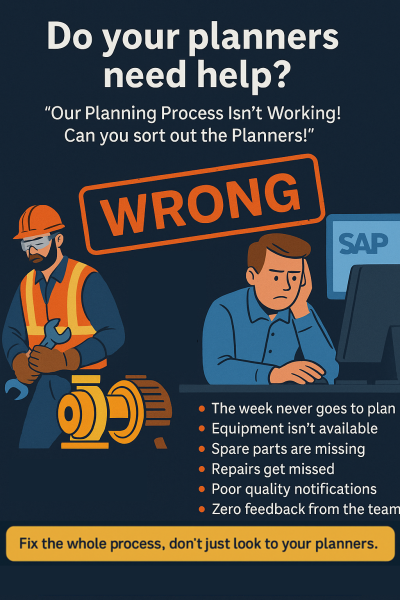
“Our Planning Process Isn’t Working – Can you sort out the Planners!”
This is something I hear often.
A business calls me in, wanting to improve their planning. “Can you help fix our planners?” I’m told they’re green, untrained, or even lazy. I get it, you’re spending a fortune on a CMMS like SAP, and you’ve got a team of planners sitting in an air-conditioned office all day, while your frontline workers are doing it tough and you feel like you’re always reactive and falling behind. So, what value are they actually adding?
After all:
- The week never seems to go to plan.
- Equipment isn’t available when needed.
- Spare parts are constantly missing.
- Critical services and repairs get missed.
- Maybe it’s time to just shut the planning team down and throw more trades at it, right?
Wrong.
Planners Aren’t the Problem, the Process Is
Every time I get invited to a new site, the biggest issues with “the planning process” I witness don’t come from the planners themselves. They come from the rest of the steps, individuals or teams involved (or not involved) in the overall work management process.
Don’t get me wrong, the planners I’ve worked with are rarely “perfect”. I’ve helped plenty of planners and planning teams sharpen up, streamline their work, and improve.
But more often than not, the planners do know what they’re supposed to do. They understand the process. They know how the system works and where it breaks down. They’re working hard to build the best plan they can, but often pushing the proverbial uphill while battling the rest of the site to make things better. I’ve seen pretty much every team I’ve worked with face these issues.
Let’s Break Down the Work Management Process
There are six steps in the typical work management process. Planners are central, but they can’t own or be responsible for every step:
1. Identify (Frontline Role)
This is the job of trades and operators. Not the planner. It’s about raising good quality notifications and clearly describing what’s wrong. And please attach photos!
2. Plan (Planner’s Role)
Yes, this is where planners come in. But planning is only as good as the information from step 1. It also relies on sound maintenance strategies and task lists, often developed by reliability engineers.
3. Schedule (Shared Responsibility)
Planners might be responsible for developing the schedule, but the quality depends on input from:
- Maintenance supervisors (who knows which trades work well together)
- Operations (who knows when equipment is available)
4. Execute (Definitely NOT the Planner)
Execution belongs to the trades and execution teams. Period. Planners should not be involved in execution. Get out and see how the job you planned is going for sure though!
5. Close Out (Frontline + Supervisors)
The person doing the job should update the work pack or CMMS system with:
- What was done
- How long it took
- Which parts were used/or not used
- What went wrong (or right)
Supervisors should review and coach. If your system allows CNF (confirmed) status or some other way to inform planners that the work is 100% completed, then the planners can close out or TECO (Technically Complete) the work order, but they shouldn’t be guessing what happened.
6. Analyse (Everyone’s Job)
This is the step most often missed.
“You can’t analyse garbage data. If feedback, history, and hours aren’t captured properly, you’ll never improve.”
You’ll just repeat the same failures, the literal definition of insanity.
The Real Fix Isn’t Just “Fixing the Planner”
So next time your planning process isn’t working, take a step back and look wider than the planning desk.
Fix the upstream and downstream processes.
Coach your frontline team on notifications. Build accountability into closeout. Get buy-in from operations and supervisors and make sure the planning meetings get the respect they deserve! And yes, support your planners, give them the tools, training and data, and respect they need.
Because when the whole work management process works together, planners become what they’re meant to be: the beating heart of reliability.
Need help transforming your work management approach?
Effective Work Solutions can help.
Company Overview:
Effective Work Solutions is dedicated to revolutionising maintenance planning and execution. The company specialises in process improvements, focusing on maintenance and shutdowns management, with the goal of driving continuous improvement in operations.
Services Offered:
- Maintenance & Work Management
- Planning & Scheduling
- Shutdown & Project Management
- SAP Master Data Implementation & Improvement
- Admin & Data Entry
- Contractor Management
- Business process improvement consulting
- Training and development of planners and SAP users
Contact:

- David Moore
- Email: admin@effectiveworksolutions.com.au
- Phone: +61 412 048 176
Effective Work Solutions – Empowering Teams, Optimising Operations.