
Identifying the Problem vs Planning the Solution: Notifications vs Work Orders
In the world of maintenance, confusion between issues/notifications and solutions/work orders is more common than it should be. Yet getting this right is one of the most critical steps in delivering effective maintenance. It’s the difference between playing whack-a-mole with plant issues, or building a sustainable, efficient maintenance system.
So why do so many organisations miss the mark on this?
Let’s start with the basics:
- Notifications are for identifying the problem.
- Work Orders are for planning the solution.
Sounds simple, right? But walk into most sites and you’ll find a very different story.
Too often, I see notifications and work orders filled with vague, poorly written text, lacking structure, standards, and clarity. And worse, organisations frequently miss the mark in two ways:
1. The Notification Jumps Straight to the Solution, Not the Problem
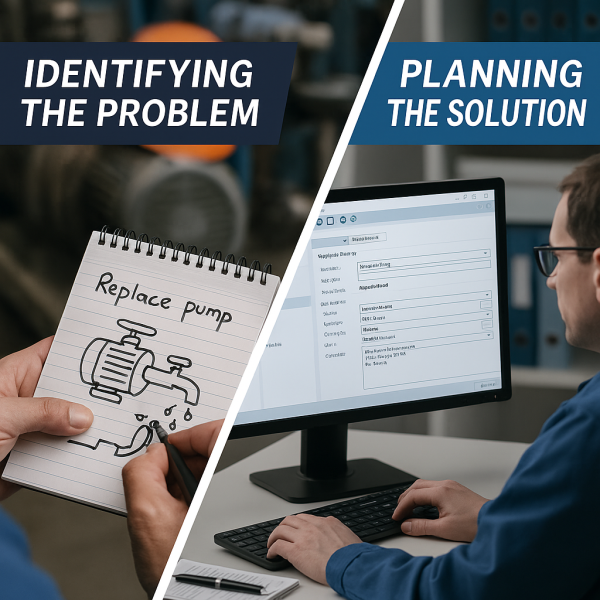
Instead of stating what’s wrong, people raise notifications like:
“Replace pump.”
That’s not a problem; it’s a proposed solution.
The correct notification should describe the symptom or failure:
“Pump 601 leaking from gland. Packing worn and dripping at 1-second intervals.”
When the notification skips the actual problem, you risk overreacting or replacing equipment unnecessarily, which could mean the difference between a $50 fix and a $15,000 replacement.
2. The Planner Just Copies the Notification into the Work Order
Even when the notification does identify the problem, I still see planners simply copy/paste the same vague text straight into the work order. No scope. No solution. No plan.
This doesn’t just waste time, it clutters your schedules and makes it very difficult to prioritise work effectively.
I’ve seen weekly schedules full of items like:
“Broken pump”
“Noisy roller”
“Gearbox leaking”
But what’s the technician meant to do with that? Is the plan to inspect, tighten, repair, replace? There’s no clarity, just a list of problems being spat out to the shop floor, leaving it up to the trades to figure it out on the fly.
Getting this right means:
- Coaching your frontline team to identify and describe the problem, not guess the fix.
- Using standard templates and check lists is not just good practice, it’s essential!
- Supporting your planners to translate that into a clear, cost-effective solution
Otherwise, you’re not planning, you’re just reacting expensively.
The Power of a Good Notification
When someone identifies an issue in the plant, whether it’s a leak, a strange vibration, or something just “not quite right”. That moment is the seed of reliability. But only if it’s captured properly.
A good notification should paint a picture. Literally. Include photos, sketches, location details, sounds, smells, whatever helps the planner understand the issue without having to leave their desk. Because if the planner can’t see the problem, they can’t plan the solution.
Unfortunately, many notifications read something like:
“Pump broken replace ASAP”
That’s not helpful. Is it noisy, leaking, hot? This will help us understand if it may be a bearing? Cavitation? Misalignment?
We need to train and coach people to report problems properly. Not just enter text in a box.
Quality Work Orders
Once the problem is clearly understood, that’s when the planner steps in and creates a work order.
The role of the planner is not to fix the pump, but to design the plan for how it will be fixed.
That means:
- Assessing the notification
- Scoping the required work
- Listing the materials and spare parts
- Estimating the labour and duration
- Scheduling the job at the right time
Yet too often, we see planners simply copy and paste the notification text straight into the work order. That’s not planning. That’s administration.
So Why Is This Still Happening?
In our experience at Effective Work Solutions, the gap comes down to one thing: lack of training, ownership and accountability.
Many frontline workers haven’t been shown how to raise a good notification. And planners are under pressure, under-resourced, or simply haven’t been empowered to do proper planning.
It’s not a software issue. It’s a people and process issue.
What We Recommend
If you want to move from reactive firefighting to structured maintenance, here’s what works:
- Coach your workforce on what a good notification looks like.
- Develop and implement standard templates and or checklists.
- Encourage photos and detail, visuals are worth a thousand words.
- Define clear roles: operators identify the problem, planners plan the fix.
- Audit work orders regularly, was the plan detailed? Was the notification helpful?
- Empower planners to push back on poor notifications.
Final Thoughts
Notifications and work orders serve different purposes. One identifies a problem, the other plans the solution. Confusing the two leads to inefficiency, wasted effort, and avoidable downtime.
Let’s stop treating the work order process like an admin task and start treating it as the foundation of plant reliability.
Need help transforming your work management approach?
Effective Work Solutions can help.